You Can Stack Numbers All Day
At Rafter 9 Ranch we watch the whole Angus market, not just our own pen. So we put two datasets side by side: the American Angus Association’s national registration records for 2020 through 2025, and our own panel of more than 90,000 bull-sale lots. One tells you what the breed is registering. The other tells you what buyers are actually paying for. Together they tell a clearer story than either does alone, and it ends somewhere a spreadsheet can’t take you.
Sires move in waves
A top AI sire has a life of about five or six years. His sons hit the registration rolls in a wave that crests four or five years after he’s born, then recedes as the next bull takes over. You can watch the crown change hands:
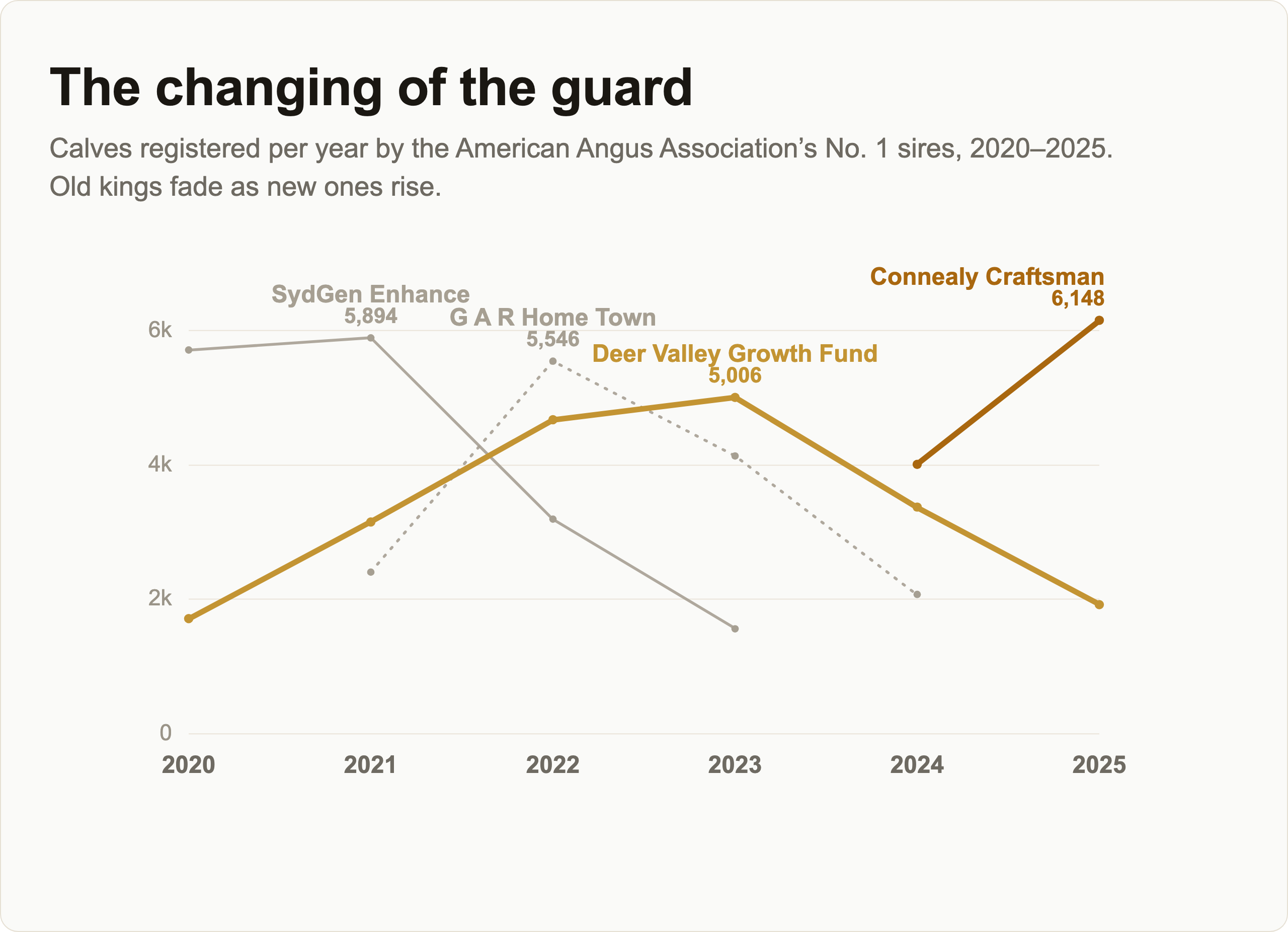
| Year | No. 1 sire by registrations | Calves |
|---|---|---|
| 2020 | SydGen Enhance | 5,710 |
| 2021 | SydGen Enhance | 5,894 |
| 2022 | G A R Home Town | 5,546 |
| 2023 | Deer Valley Growth Fund | 5,006 |
| 2024 | Connealy Craftsman | 4,014 |
| 2025 | Connealy Craftsman | 6,148 |
Our sale ring runs the same wave about two to three years behind, because a bull’s sons reach the auction after his registration peak. The trendsetters move first, the registrations follow, the sale ring follows that.
Two instruments, one picture
Here’s the part that gives us confidence: our sale panel, built independently from a completely different data source, lands on the same names AAA does, right down to the obscure ones. The sires climbing fastest in our auction data, including lesser-known bulls like Stellpflug Hoffman RiseAbove and B A R Dynamic, are the same bulls climbing AAA’s national registration list. When two instruments built from different data agree, you trust the reading.
The breed is marbling up, and the market’s top sires are far ahead of it
This is the finding that matters. The Angus breed’s average marbling has climbed hard, from about +0.46 in 2010 to +0.80 by 2023. That is the breed’s realized response to a generation of selection, the whole population lifting.
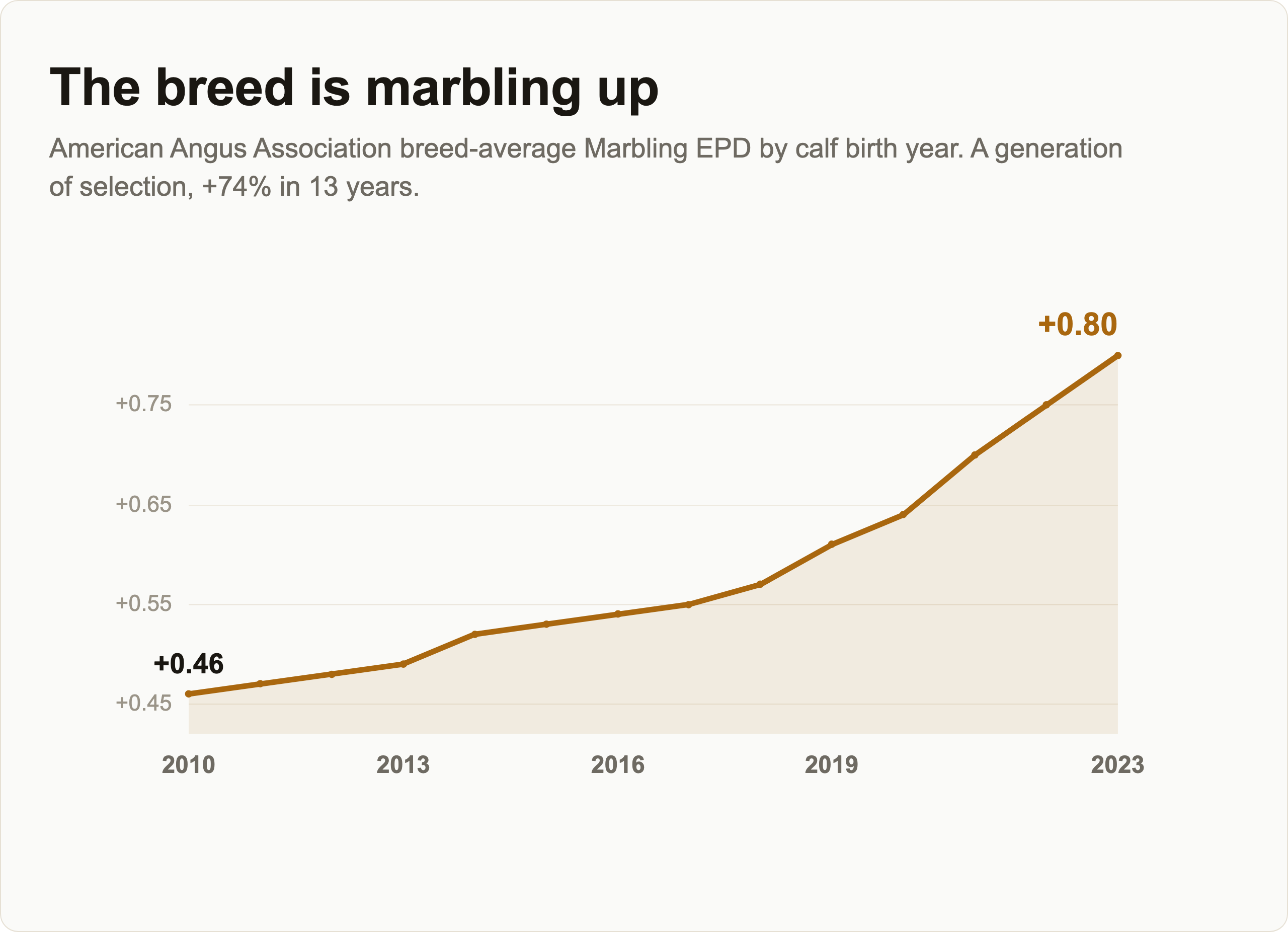
So we asked a harder question: how far ahead of that rising line are the bulls the market actually uses? We measured every top-registration sire against the breed average for his own birth year, so a newer bull gets no credit simply for being born into a better base. The answer is: a long way ahead, and consistently. The bulls the market bred to sat well clear of their own birth-year breed average on marbling across 2020 to 2025, and the gap grew. It held up even when we set aside each year’s single biggest sire. On $C, the combined profitability index, the same gap runs +$60 to +$90-plus a year, though $C only launched in mid-2020, so we lean on it lightly. Meanwhile the growth advantage held steady, and the calving-ease margin gave a little ground.
So we pushed harder on it. The breed’s own marbling hasn’t just risen, its spread has widened, which means a bigger number today isn’t automatically a more elite one. When we account for that wider spread, the market’s marbling premium still grew: from roughly nine-tenths of a standard deviation above the breed in 2020 to about one and a half by 2025. The pull toward marbling is real, and it sharpened. The one caveat we can’t fully close: the newest sires’ marbling rests heavily on genomic prediction and may settle back as their real progeny records come in.
Put plainly, the breed is improving fast, and the market’s top sires sit even further ahead of it on carcass every year, while holding growth. It’s a numbers race, and it’s real.
But the numbers aren’t the animal
Now look at which bulls actually last. Deer Valley Growth Fund, born in 2017, held a top-ten registration spot five years running. Tehama Tahoe B767, born in 2013, was still a top-five registration sire in 2024, more than a decade out. The bulls with staying power aren’t always the ones with the flashiest single number. They’re the ones that kept working, that kept producing cattle people wanted, year after year. And in a small side-by-side we ran, five staying-power sires against five carcass risers on current numbers, the durable bulls carry modestly better udder, teat, scrotal and foot EPDs, the traits tied to a cow that breeds back and stays sound, even while they trail on marbling. Five and five is a small sample and we hold it loosely, but it points the same direction as what we see on the ground.
That’s the pattern worth watching. You can stack numbers all day. A bull can win on paper and still throw daughters that leave the herd early, feet that break down, cows that miss. The index doesn’t know whether a cow is still working in her tenth year. It can’t see her udder, her feet, her disposition, whether she breeds back every fall on grass.
What we’re building at Rafter 9 Ranch
We treat the numbers as table stakes. Marbling, growth, calving ease: we want them, we track them, we won’t apologize for good data. But they’re the price of admission, not the whole hand. What we select for is the animal the numbers can’t fully capture: structure, feet, fertility, disposition, the cow that stays sound and stays in the herd, the bull that holds up on our ground.
That’s the standard we hold ourselves to, and it’s the standard we cull to. The market is telling us where the paper is going. We’re paying attention. But we’re building for the part of the animal that outlasts the paper.
About the data: AAA registration counts and the breed genetic trend are from the American Angus Association’s public records (Top 25 Sires by Registration, 2020-2025, and the Genetic Trends by Birth Year). Our sale panel is a national but non-census scrape of public Angus bull-sale results, heaviest in the Western sales we track most completely. Sire EPDs are current AAA values, not the values published when a sire’s sons sold. The “elite margin” measures each sire against the breed average for his birth year; coverage runs 73-91% of registration weight per year.